
Introduction:
Let me paint a picture that is painfully familiar to the ambitious Nigerian professional.
You find a beautiful property you want to buy. Let’s say it costs ₦80 Million and you currently have ₦30 Million. A standard traditional financial advisor would tell you to be disciplined, to put your money in a savings account, cut your expenses, and save aggressively for the next two years until you have the full ₦80 Million in cash.
So, you do exactly that. You hustle, you save, and 24 months later, your bank balance hits exactly ₦80 Million. You excitedly call the developer to buy the house.
The developer picks up the phone and says, “Ah, well done! But that house is now ₦130 Million.”
Your heart sinks. Despite doing everything “right,” the house is now further out of your reach than it was two years ago. This heartbreaking phenomenon is not a result of bad luck. It is a mathematical certainty in our current economy, and financial experts call it the “Cash Drag.”
If you are looking for ways to protect cash from inflation, the worst thing you can do is let it sit idle. Here is why saving up a lump sum to buy a house in Lagos is financially draining and dangerous, and exactly what you should do instead.
What is a “Cash Drag”?
The Cash Drag occurs when the rate of inflation outpaces the interest you are earning on your cash.
When you ask traditional financial advisors how much to save before buying a house, they often advise having 100% of the cash or at least an unnecessarily huge 70% lump sum. But they are calculating this using math that doesn’t apply to the Nigerian economic reality.
Let’s look at the numbers. According to recent macroeconomic data from Nairametrics, inflation in Nigeria has consistently hovered at levels that make traditional savings obsolete.
If your bank gives you a 10% interest rate on your savings, but the inflation rate (the rising cost of goods, cement, and land) is 25%, your real return on investment is negative 15%.
Every single day your money sits in the bank waiting for you to “save up,” it is actively losing its purchasing power. The cash is dragging your net worth backward.
Real Estate vs. High-Yield Savings Accounts
When you leave ₦50 Million in a high-yield savings account or fixed deposit, the bank does not lock it in a vault. They take your cash and lend it to real estate developers at a 25% to 30% interest rate. The developer uses your money to build premium houses.
Because the cost of building materials rises with inflation, the developer increases the selling price of the completed houses. The bank makes huge profit on the loan, the developer makes a massive profit on the property appreciation, and they hand you back your 10% interest-which can no longer afford the house they just built with your money.
In the battle of real estate vs. high-yield savings accounts, the physical asset wins every single time because tangible assets absorb inflation.
(We broke down this exact mechanism deeply in our recent analysis: Inflation-Proofing Your Portfolio: Why Tangible Assets Beat the Stock Market).
The Solution: Speed-to-Equity (Entering the Market Early)
If saving up is a trap, how do you actually acquire property?
You execute a strategy called Speed-to-Equity through off-plan property investment.
Instead of saving for two to three years to buy a finished property at tomorrow’s inflated prices, your goal should be to enter the market today with whatever deposit you have, locking in today’s price.
Here is how Speed-to-Equity works:
- The Price Freeze: You find a premium off-plan development (like Greystone Residence in Maryland). The unit costs ₦320 Million today.
- The Early Entry: Instead of waiting to save ₦320M, you pay the 30% initial deposit.
- The Inflation Reversal: The moment you sign the contract, the price of your unit is legally frozen at the agreed amount of ₦320 Million. Over the next 18 months, as inflation drives up the cost of cement and labor, the market value of that unit might rise to ₦320 Million.
- The Result: Your remaining balance is still based on the old ₦320M price, but you now own an asset worth ₦370M.
You are no longer a victim of inflation; you are successfully riding the inflation wave. (If you are a young professional trying to map out this journey, you need to read our step-by-step blueprint: From Tenant to Landlord in 5 Years).
Using Payment Plans as an Inflation Hedge
At Casafina Development, we understand that asking buyers to drop hundreds of millions in raw cash limits wealth creation.
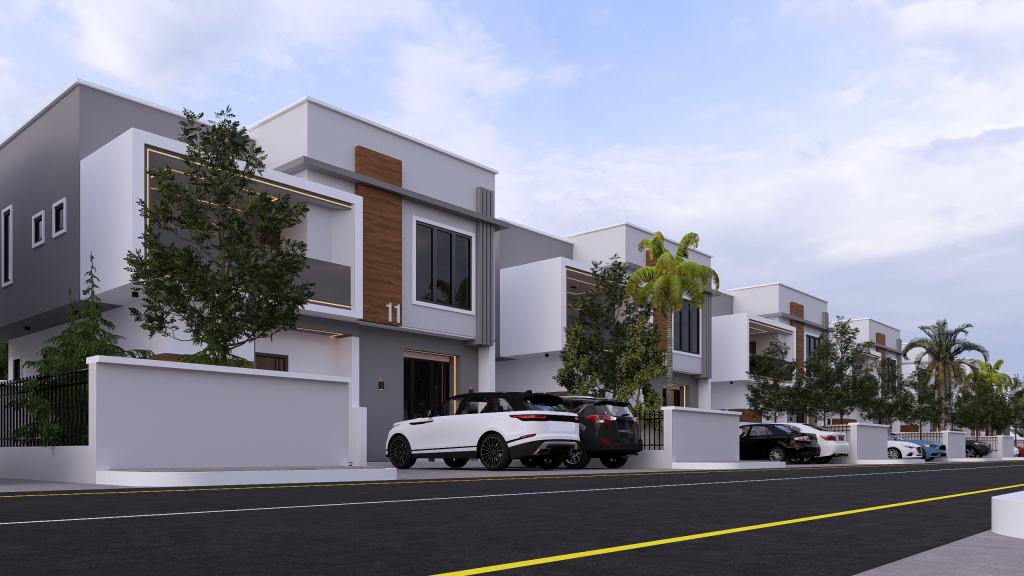
This is why our projects-from the serene, master-planned apartments at Vedura Grove to the luxury terraces and maisonettes at Greystone Residence in Maryland-are structured around highly flexible, investor-friendly payment plans.
By utilizing our structured payment milestones, you deploy your cash strategically. You put down your initial deposit to freeze the property cost, and you spread the balance over the construction lifecycle.
If you want to stretch your payment out even further without feeling the cash drag, you can bridge the gap using leverage. (We explain exactly how to do this safely in our most popular guide: The 40% Rule: How to Safely Leverage a Mortgage for Off-Plan in Nigeria).
Conclusion
You should not stockpile raw cash in bank accounts, rather deploy it into appreciating assets as quickly as possible.
In a high-inflation economy, patience is not a virtue; it is a financial penalty. If you have the equity to deposit on a secure, high-yield property today, do not wait until next year. The market is not waiting for you to save up.
Are you ready to stop the cash drag and lock in your property value today?
Do not let inflation erode your hard work. Contact our advisory team to explore flexible, inflation-hedging payment structures for Greystone Residence, and Vedura Grove.