
Buying land or property in Lagos is one of the surest ways to build long-term wealth. However, many first-time investors and experienced buyers make a critical budgeting mistake: they only calculate the actual purchase price of the property, forgetting about the official government charges, legal fees, and statutory taxes required to secure full legal ownership.
When these extra costs catch buyers by surprise, it can delay title perfection, stall development, or create unexpected financial strain.
If you are planning to purchase real estate in Lagos State, understanding the land charges payable on property transactions in Lagos will help you budget accurately before making a deposit.
Here is a clear, plain-English breakdown of statutory fees and closing costs.
The Essential Land Charges and Statutory Fees in Lagos
When you buy property in Lagos, statutory fees generally fall into four main categories: State Government Perfection Fees, Professional and Legal Fees, Estate Development Charges, and Recurring Annual Taxes.
Under the Fair Market Value (FMV) “Blue Book” framework implemented by the Lagos State Lands Bureau, official property valuations used to calculate these fees reflect updated market baselines. While the underlying mathematical percentages remain structured similarly, the actual monetary costs have adjusted across prime and emerging corridors because government baseline property values have been revised upward to match true market values.
1. State Government Perfection Fees (Governor’s Consent & Registration)
To make your property purchase legally binding under the Land Use Act, you must register the transaction and obtain Governor’s Consent. Government perfection fees are calculated as a fixed percentage of the officially assessed commercial value (the FMV Blue Book rate) of the property, not the lower price you might have privately negotiated with the seller.
The total percentage-based charges amount to 3% of the property’s officially assessed value, broken down as follows:
Governor’s Consent Fee (1.5%): Paid to the Lagos State Government for approving the transfer of ownership or interest from the seller to you.
Capital Gains Tax (0.5%): A statutory tax levied on the gain or profit realized from the asset sale.
Stamp Duty (0.5%): Paid to the state tax authority (LIRS) to legally stamp and authenticate your Deed of Assignment.
Registration Fee (0.5%): The fee required to formally record your title details in the Lagos State Land Registry records.
Note: In addition to this baseline 3%, you must budget for fixed-rate auxiliary fees including the Capital Contribution Levy, Charting Fees, and Neighborhood Improvement Charges (NIC), which are also assessed under the official framework.
2. Professional and Legal Fees
Securing legal and physical verification requires factoring in standard industry professional fees, which are calculated based on the actual transaction value:
Legal Fees (5% to 10%): Paid to your real estate attorney for conducting root-of-title searches, legal due diligence, drafting the Deed of Assignment, and handling execution.
Survey Fees: Paid to a licensed surveyor to chart land boundaries. Survey scales are strictly zoned by the Lagos State Surveyor General’s office, ranging from roughly ₦425,000 to ₦1,575,000 per plot depending on the tier of the location (e.g., Zone A prime vs. Zone E (rural), which includes mandatory storage of the official “Red Copy”.
3. Estate Development & Administrative Charges
If you are purchasing a property inside an organized layout or gated estate, you will encounter localized administrative costs:
Infrastructure / Development Levy: A one-time fee charged by the developer to cover internal paving, drainage systems, electrification, and security infrastructure.
Service Charge & Connection Fees: Recurring or initial payments required to access central estate utilities, water treatment, waste management, and estate security.
4. Recurring Annual Charges: Land Use Charge (LUC)
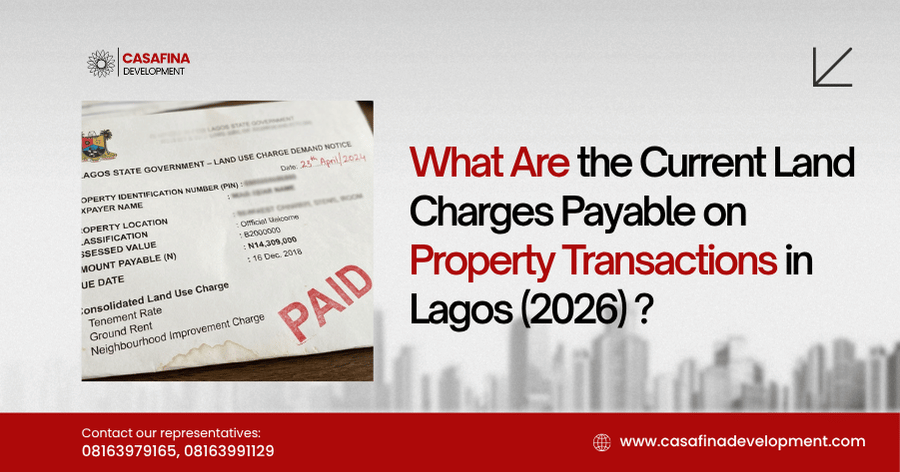
Once you own property in Lagos, you are subject to the Land Use Charge (LUC). This is an annual property tax consolidated by the Lagos State Government that combines former tenement rates, ground rent, and neighborhood improvement charges into a single annual payment. The exact amount depends on the property’s assessed market value and its classification (e.g., raw land, owner-occupied residential, commercial, or industrial development).
How Can I Avoid Hidden Costs When Buying Property?
Knowing what land charges are payable on property transactions in Lagos helps you plan your total acquisition budget accurately before signing any contracts.
To ensure a smooth, surprise-free purchase:
Request a Total Cost Breakdown Upfront: Before making a deposit, ask for a clear itemized breakdown that includes the property cost, legal fees, survey fees, and perfection charges.
Buy Pre-Vetted Estate Assets: Investing in structured estates with clear, pre-vetted titles simplifies the perfection process and protects you from double payments or disputes. (To see how buying in a structured estate compares to buying standalone land, read our guide on Single Plot vs. Estate Development in Lagos: Which Is Better?,
Budget an Extra 10% – 15% Above Purchase Price: As a general rule of thumb, always set aside 10% to 15% above the land price to cover all closing costs comfortably.
Making Informed Real Estate Investments
Factoring in all official land charges payable on property transactions in Lagos from day one ensures that your capital is fully protected and your property title is perfected without administrative delays.
Whether you are land banking in fast-growing corridors or purchasing serviced estate plots, factoring in closing costs from day one helps you build a secure, hassle-free real estate portfolio.